
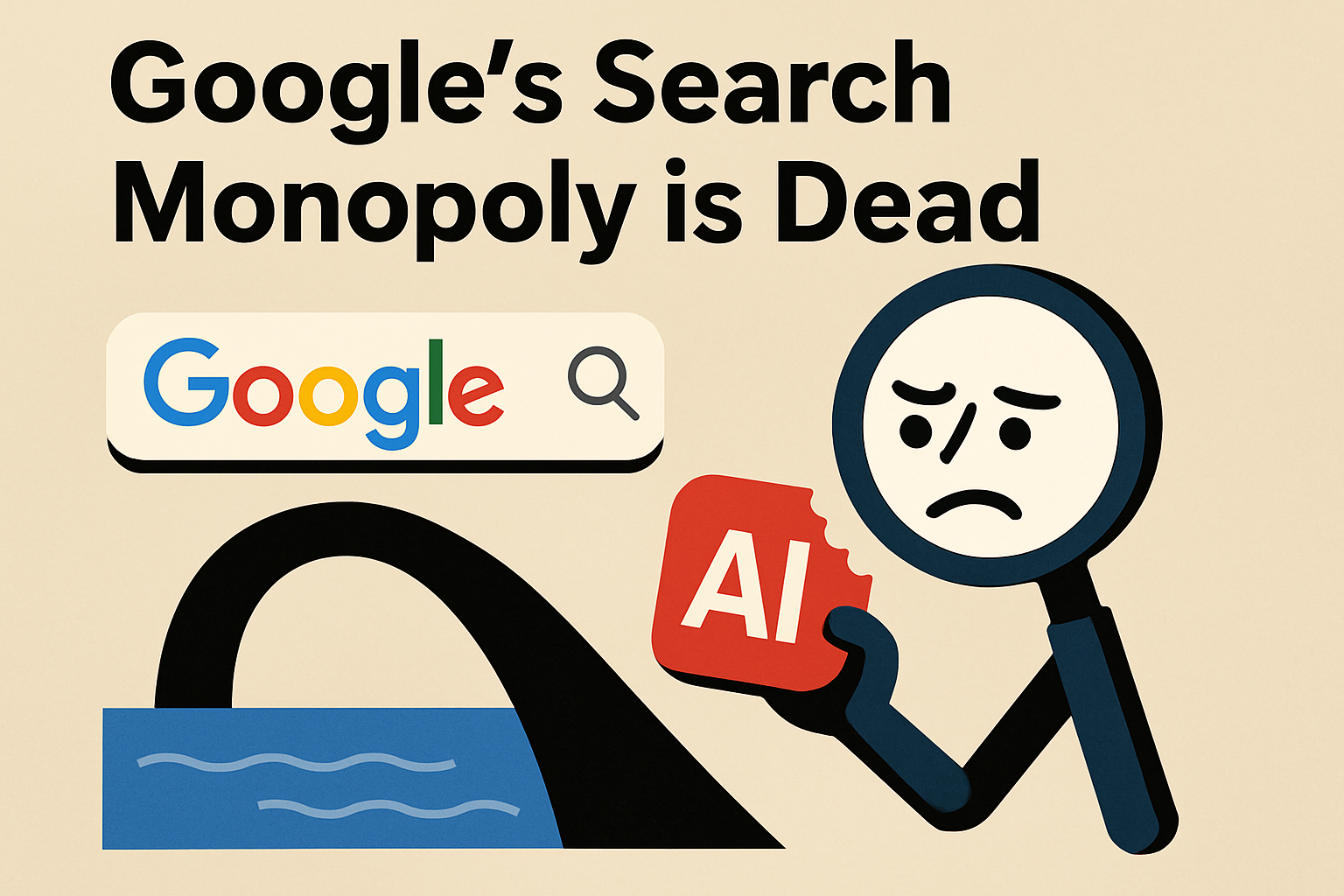
Google has long held a dominant position in the search engine market, a fact that has been both a blessing and a curse. There are reasons I love Google and reasons I really, profoundly dislike Google. Some of the things they've done have really helped civilization in the United States. Google Maps, for example—I don't know where we would be without it. I think the U.S. government should buy it. It's a crucial tool for navigation and has transformed how we travel and explore our cities.
Watch the source video:
On the flip side, Google Search propelled us into the modern age, yet it also wielded its power like a sledgehammer. At one point, Google had a staggering 93% monopoly in search. They were paying congresspeople and senators, and paying all over the place, to ensure that they didn’t face repercussions for their stronghold on the market. Ten years ago, they should have been broken up, but all that is water under the bridge at this point.
Fast forward to today, and we find ourselves in the midst of an AI revolution that is fundamentally reshaping how we interact with information online. Because of AI, we have Claude AI, Google's Gemini AI, Grok AI, and ChatGPT AI, along with lots of smaller ones. But those are the four big ones right now, and each of them is taking a bite out of Google Search.
In my previous life as a professional SEO technician back in 2009 and 2010, our goal was straightforward: get a website ranking in the top 10 for a lucrative keyword phrase. For instance, "top New York City slip-and-fall attorney" could yield significant business for whoever ranked in the top three positions. Those were the days when search results were dominated by a list of links, with the top ten websites vying for your click. But those days are over.
Now, if you go to Google and type a search query, it doesn't give you the top 10 anymore. Instead, it offers AI-generated responses, often prioritizing summaries and direct answers over traditional links. It might give you website listings, but it will only show four or six options, if that. The classic search engine results page with ten websites is a relic of the past—it's gone, and it's history.
This shift is indicative of a broader trend where technology evolves so rapidly that it can sometimes eat its own tail. Google Search, as we once knew it, is kind of over now. It's evolving into AI search, and this presents both challenges and opportunities for businesses and content creators alike.
The impact of AI on search engines is profound. Publishers are having to adapt their strategies to align with this new landscape. According to a recent analysis, the rise of AI in search means that content creators need to rethink how they present their information and engage their audience, as traditional SEO tactics are becoming less effective in the face of AI-driven search results Google AI Overviews Impact On Publishers & How To Adapt Into 2026.
As we navigate this transition, it's essential to recognize that while Google's hold on search may be loosening, the need for reliable, high-quality information is more critical than ever. AI can provide answers quickly, but it doesn't always ensure those answers are accurate or comprehensive. This is where the human touch—critical thinking, creativity, and context—remains invaluable.
In conclusion, Google's search monopoly may be fading into the past, but that doesn't mean we should take our eyes off the ball. The AI revolution is here, and it will continue to shape how we find and consume information. As we embrace this new era, it’s important to remain vigilant and adaptable, ensuring that we not only keep pace with technological advancements but also maintain our commitment to quality and integrity in the information we share.
